
First Territorial Futures Forum in Nicosia
News articles
April 26, 2026
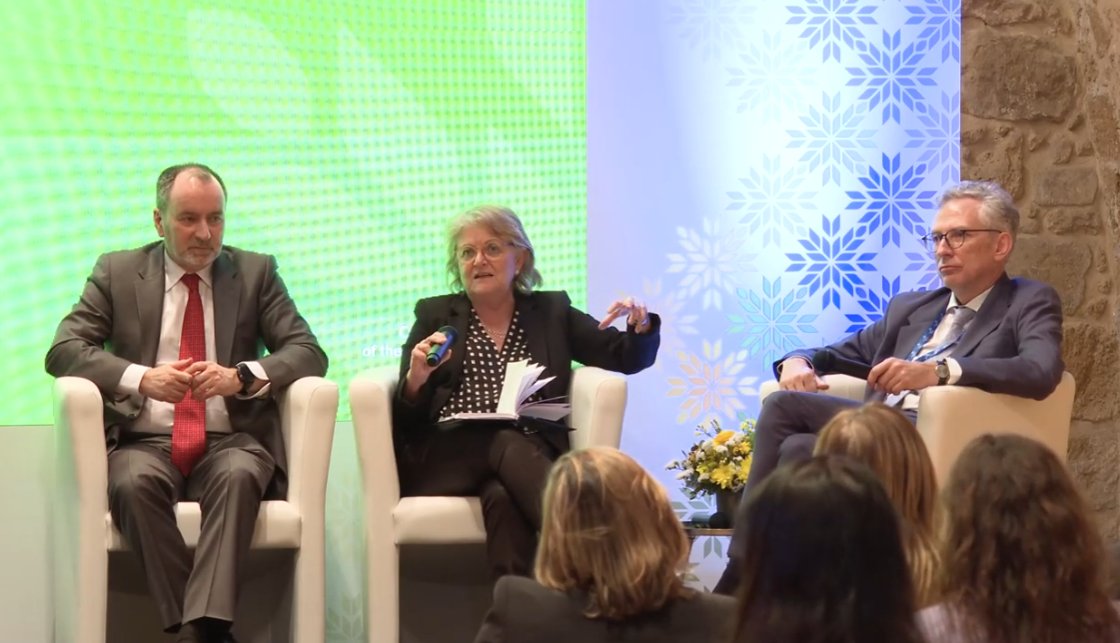
On 14 April 2026, in Nicosia, the inaugural session of the Territorial Futures Forum (TFF), organised by the Cypriot Presidency of the Council of the EU with the support of ESPON, brought together high level policymakers, senior EU officials, experts Member State representative and the group of the TFF experts, for a four-hour debate on the structural conditions shaping European territories in the light of the new programming period.
The TFF is a high-level policy platform that brings together Member States' Directors-General for Territorial Cohesion and Urban Matters, the European Commission, European institutions, umbrella organisations and independent experts to enable dialogue on the strategic orientations, concrete policy options and recommendations on how to achieve the desired Europe’s territorial future. You can find more information about the role and the participants of the TFF on the dedicated page of our website.
Opening the Forum
The session opened with three introductory contributions framing both the policy stakes and the cultural setting. Constantinos Ioannou, Minister of Interior of the Republic of Cyprus, stated that territorial cohesion is not a secondary social concern but a fundamental driver of European competitiveness. He called for a "resilience-based" approach to regional planning, one that allows territories to absorb external shocks without losing their unique identity. And he emphasised the importance of continuity within the Trio Presidencies to keep territorial development on the EU's political agenda. ESPON EGTC Director, Wiktor Szydarowski, introduced the forum's institutional logic: a seven-session mechanism designed to translate ESPON's empirical research into actionable policy orientations for Directors-General of Territorial Cohesion and Urban Matters across successive presidencies. Aliki Stylianou, Director of the Press and Information Office of Cyprus, added a distinctive opening note by presenting the film Medieval Lefkosia: Birth City, grounding the day's abstract discussions about territorial futures in the tangible historical depth of the host city itself.
Enrico Letta: The Right to Stay
The keynote address by Enrico Letta, President of the Jacques Delors Institute and former Prime Minister of Italy, was the intellectual centrepiece of the session. Letta argued that the Single Market requires a structural evolution: the addition of a "fifth freedom", the free circulation of knowledge, research, and innovation, to sit alongside the existing four freedoms. The Single Market, argued Professor Letta, has operated with a form of "geographical blindness," prioritising central efficiency while ignoring what happens to the regions left behind. The result is a self-reinforcing concentration of talent and capital in a handful of metropolitan hubs, driving a brain drain from the periphery that erodes both economic capacity and political trust in the European project. The most resonant concept of his address was the "right to stay", the principle that citizens should not be forced to uproot themselves for economic survival. For Letta, this is not sentimentalism; it is a precondition for the political sustainability of European integration. A Union where cohesion is a slogan but centralisation is the operating logic will, he warned, continue to generate the anti-EU sentiment it claims to want to counter.
Andrés Rodríguez-Pose: The Revenge of Places That Don't Matter
Andrés Rodríguez-Pose, Professor of Economic Geography at the London School of Economics and a member of the TFF expert group, delivered a data-driven analysis of what he calls the "development trap." He identified the regions most at risk as the EU redesigns its investment architecture: territories too prosperous to qualify for the highest tier of cohesion support, yet too unproductive to compete in the knowledge economy. These middle-income regions have stagnated for over two decades, and the political consequences are measurable: a direct statistical correlation exists between long-term regional stagnation and the rise of political polarisation, what Rodríguez-Pose describes as "the revenge of the places that don't matter." His prescription is a direct challenge to the dominant efficiency logic of EU competitiveness policy: rather than channelling investment into already-productive centres under a "space-neutral" framework, Europe needs place-based strategies built around local institutional quality and each territory's specific industrial heritage.
In the subsequent panel debate, participants raised concerns about the design of the European Competitiveness Fund, questioning whether a purely productivity-driven instrument would serve stagnant middle-income regions at all. Rodríguez-Pose agreed, stressing that investment must be paired with institutional reform to break the trap — and that the political cost of ignoring these regions is a fragmented Union where the benefits of integration remain inaccessible to large parts of the population.
Elisa Ferreira: Cohesion as Strategic Autonomy
Elisa Ferreira, the lead of the TFF expert group and former European Commissioner for Cohesion and Reforms, anchored her contribution in the geopolitical and environmental realities that are now reshaping territorial development. Her central proposition - "do no harm to cohesion" - is a demand that every EU-level policy decision, from the Green Deal to the Digital Decade, undergo a systematic territorial impact assessment. If a policy structurally benefits central regions at the expense of peripheral ones, it must include mitigating spatial measures. On the energy transition, she was direct: regions dependent on fossil fuels face an existential challenge, and a transition that is not socially fair and spatially balanced will generate resistance capable of derailing climate ambition.
The panel discussion following her remarks focused particularly on island and border regions, with Cyprus as the immediate case in point, pressing on whether connectivity and resilience commitments would translate into concrete legislative measures in the post-2027 architecture. Ferreira concluded by reframing cohesion in security terms: resilient regional economies are not simply a social good but the industrial and social backbone of European strategic autonomy.
Hugo Sobral: Bridging Vision and Legislation
Hugo Sobral, Deputy Director-General of DG REGIO at the European Commission, provided the institutional bridge between the session's high-level concepts and the practical legislative realities of the post-2027 EU budget. He focused specifically on the proposed European Competitiveness Fund, warning against a scenario of "geographic sacrifice" in which the drive for industrial sovereignty leads investment to concentrate solely in established economic engines. Sobral outlined the Commission's current approach: a "cohesion-aware" competitiveness model designed to identify and support regional innovation ecosystems across all Member States, rather than allowing a two-tier Europe to emerge, in which some regions lead the digital transition while others are reduced to passive consumers of centrally produced technologies. His intervention gave concrete legislative weight to what Letta, Rodríguez-Pose, and Ferreira had argued more broadly, and signalled that DG REGIO intends to hold the competitiveness agenda to a territorial standard.
Scenarios and Closing Remarks
Closing remarks were delivered by Kyriakos Koundouros, Director of the Department of Town Planning and Housing, who summarised the day's key findings and underscored the importance of integrating urban and territorial perspectives to address the asymmetrical impacts of the green and digital transitions. The findings from Nicosia now set the baseline.
The next TFF meeting will be held in Dublin under the Irish Presidency.

