Resilient Supply Chains for the future. What Europe's regions need today?
News articles
September 25, 2025
Efstathios Kassios, economist, member of the ESPON editors' team
The EU is currently facing significant challenges amidst growing geopolitical tensions, conflicts, trade disruptions and changes. From the war in Ukraine to U.S. tariffs, global trade uncertainty is increasing, affecting imports, exports, investments, and strategic dependencies.
For many years, European countries have relied on critical inputs for key sectors such as semiconductors, energy, raw materials, and minerals. Regardless of the readiness at the national or EU level, many regions now face pressure to adopt new policy measures to build resilient supply chains and reduce exposure to external shocks. This aligns with EU initiatives like the Open Strategic Autonomy (OSA), designed to help regions attract investment, support territorial growth and secure greater independence. Long-term economic stability and territorial cohesion will depend on how well European regions can adapt to supply chain shocks while securing a path to sustainable growth.
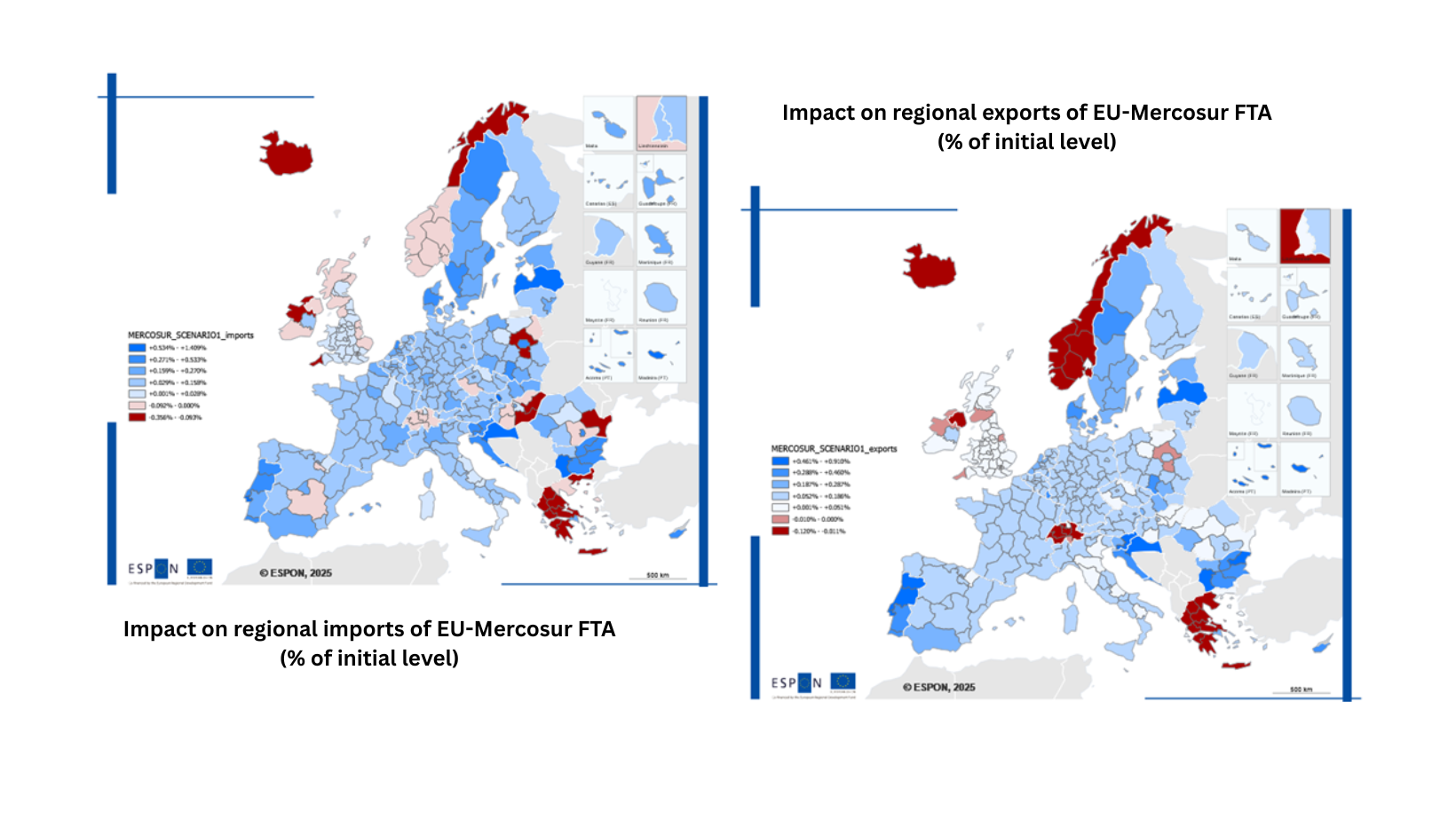
Trade disruptions affect regions unevenly, depending on their economic structures, sectoral specialisation and integration into global value chains. According to a study by the OECD, the challenge for Europe is to balance long-term growth with economic security when embracing open markets through the international trading system. Data and insights from the ESPON STARTER Project further support the diversification in regional resilience. Southern and eastern European regions such as Greece, Bulgaria and Romania, for example, are projected to benefit most from Free Trade Agreements (FTAs) like EU-Mercosur, with export gains exceeding +0.40% in agriculture, food processing and medium-tech manufacturing. By contrast, regions with limited diversification, particularly in agri-food or low-tech sectors, remain more exposed to shocks.
These disparities underscore the importance of building resilience from the ground up, informed by scientific evidence and tailored solutions, and adapting to regional needs and local infrastructures. Strategic trade agreements can play a key role not only to diversify supply sources and strengthen European value chains, but should also function as instruments of geopolitical stability and regional development, aligning with the prioritised policies of the European Council.
Modern Free Trade Agreements (FTAs) are essential instruments for resilience. Strategic engagements with China can secure access to critical raw materials like lithium and nickel, which are vital for the green and digital transitions, expand Europe’s network of trade partners, reduce exposure to protectionist policies such as U.S. tariffs and embed shared values in trade frameworks, including labour rights and environmental standards. Mercosur (Argentina, Brazil, Paraguay, Uruguay) is also important for Europe for enhancing its competitiveness among global trade players and securing alternative supply chains.
Evidence from impact assessments indicates that the EU-Mercosur agreement could increase EU imports by 0.106% and exports by 0.116% on average, with more significant impacts in specific regions, depending on their trade exposure and sectoral strengths. These trade partnerships can partially offset export losses in markets like the U.S., while supporting the EU’s OSA agenda. Non-EU countries such as the UK and members of the EFTA (European Free Trade Association) are expected to experience negative or minimal effects, underscoring the strategic advantages of EU membership.
Trade diversification alone is not enough. What European regions need today is building robust supply chains that require targeted investment and structural adjustments in specific priority areas, such as promoting circular economy initiatives, recycling to reduce reliance on primary raw materials, supporting SME internationalisation, particularly in regions with limited trade openness, investing in workforce upskilling and reallocation, especially where sectoral transformations due to trade disruptions are imminent.
Regions with diverse supplier bases and flexible industrial structures achieve stronger economic and employment outcomes. For example, North Portugal (Norte), with its diverse export portfolio and industrial base, is expected to benefit from the EU–Mercosur agreement. In contrast, some eastern European regions with concentrated supplier dependencies or low-tech specialisation may face adjustment pressures, particularly in agriculture and manufacturing. According to Kurt Kratena, STARTER Project Leader, strategic trade agreements help regions to diversify their supply sources and build resilience into European value chains. They are not just economic tools but also instruments of geopolitical stability and regional development.
“Achieving strategic autonomy demands both supplier diversification and internal capacity building — regional investments in infrastructure, skills, and circular systems are key to resilience.”
Kurt Kratena, STARTER Project Leader
The EU is actively deploying various policies and instruments to reduce strategic dependencies, enhance supply chain resilience and achieve strategic autonomy. Key initiatives include the CRM Act (Critical Raw Materials Act) which boosts domestic sourcing and processing capacity while securing inputs for the green, digital and defence sectors, strategic FTAs (Free Trade Agreements) to broaden Europe’s trade partnerships and avoid or reduce the negative impact of tariffs, Cohesion Policy instruments that support territorial balance and assists economically or politically vulnerable regions where the workforce needs reskilling. These tools reflect the EU’s evolving approach to Open Strategic Autonomy, balancing economic openness with the need to shield its economies from external disruptions.
Building resilient supply chains is no longer just a matter of trade or industry; it is a crucial aspect of global economic stability. It is a territorial imperative. Europe’s future prosperity will depend on its ability to empower regions with the tools, investments and strategies needed to adapt to a shifting global landscape, even if geopolitical challenges persist. Research and findings from initiatives such as the ESPON STARTER Project highlight where vulnerabilities lie and how evidence-based policymaking can strengthen regional resilience.
As global geopolitical risks intensify, Europe’s resilience must be built region by region, supported by coordinated EU and national interventions.
Efstathios Kassios, economist, member of the ESPON editors' team