
IMAGINE - Developing a metropolitan-regional imaginary in Milan-Bologna urban region
Projects
May 2020 - May 2021
EUR 210,000.00
The Milano-Bologna urban region encompasses the metropolitan cities of Milan and Bologna and the provinces of Piacenza and Pavia, a strategic regional area across two of the most economically developed Regions in Italy. This area experiences important changes in terms of economic development. Actually, the whole area can be seen as a growth corridor inside which traditional economic development processes keep following the logic of agglomeration, but also as a growingly differentiated regional space where unexpected economic processes are investing unusual places and leaving behind or questioning historical patterns of centrality and competitiveness.
This functional area, despite being characterized by proximity and continuity is subdivided into two metropolitan cities, two provincial institutions and two Regions. There is no common governance framework able to deal with the challenges generated by the consequences of the above-mentioned socio-spatial and economic changes. Moreover, the absence of a common narrative in policy design and strategies – which can also be called a lack of spatial imaginary - is a serious challenge for territorial cohesion as it risks producing much differentiated patterns of economic development, reinforcing old- or producing new territorial unbalances.
ESPON IMAGINE shall develop a common narrative as well as the basis for an integrated territorial strategy within the Milan-Bologna area, addressing most recent economic trends and their territorial impacts. The main outcome should be a concrete list of recommendations and support mechanisms in each stakeholder territory.
In the longer term, the objective is to turn informal coordination into more formalized cooperation to establish joint spatial scenarios and policies, eventually delivering an experimental Integrated Territorial Investment proposal.
Policy questions
- What are the main drivers (economic, social, spatial, environmental, technological, political etc.) and actors that are likely to shape spatial development and integration of the Milano-Bologna territory in the near future?
- What are the current potential blocking factors for developing an interrelated spatial imaginary in policy design and strategies (in terms of bureaucratic barriers, governance, financial and administrative capacities)?
- What have been the impacts in terms of territorial integration of the development of Milano high-speed rail? Broadly, to what extent mobility and connectivity could constitute a key factor in a successful integration of the functional area?
- Does the shift in economic activity in the urban region reconfigure the spatial equilibrium between metropolitan cities and their in-between provincial territories?
- How to tackle territorial inequalities when agglomeration effects are consolidating cumulative economic growth reinforcing the central-periphery patterns?
- Which territorial sustainable and inclusive development scenarios within the Milano-Bologna functional area develop, taking into account the shift in the economic activity and the changing role of territorial authorities?
- Which policy tools and governance approaches can be useful and sensible to plan and manage spatial development at Milano-Bologna functional scale? How relevant would be the ITI tool as a new form of coordination in that territorial framework?
- To what extent the different stakeholders involved in this process are willing and are able to contribute to a potential ITI (or other more relevant tool identified) preparation and implementation?
Main outcomes
- An overview and a mapping of existing cooperation / coordination / initiatives / functional complementarities within the Milan Bologna functional area;
- A case study on the Milan-Bologna high-speed rail providing an overview of main challenges and potentialities related to the transportation system within the functional area;
- A step-by-step strategy for implementing the relevant spatial integration scenario, following the priorities identified and including the use of the relevant tools.
Stakeholders
- Milan Metropolitan City (lead stakeholder), IT
- Metropolitan City of Bologne, IT
- Province of Pavia, IT
- Province of Piacenza, IT
- Associazione Interessi Metropolitani, IT
- City of Warsaw, PL
- METREX - network of European metropolitan regions and areas, BE
- POPSU- Observatory platform for urban projects and strategies, FR
Contractors
- Politecnico di Milano (lead contractor), IT
- Globus et locus, IT
- Sciences Po, FR
Deliveries
- Inception delivery: 26 June 2020
- Interim delivery: 11 January 2021
- Final delivery: 26 May 2021
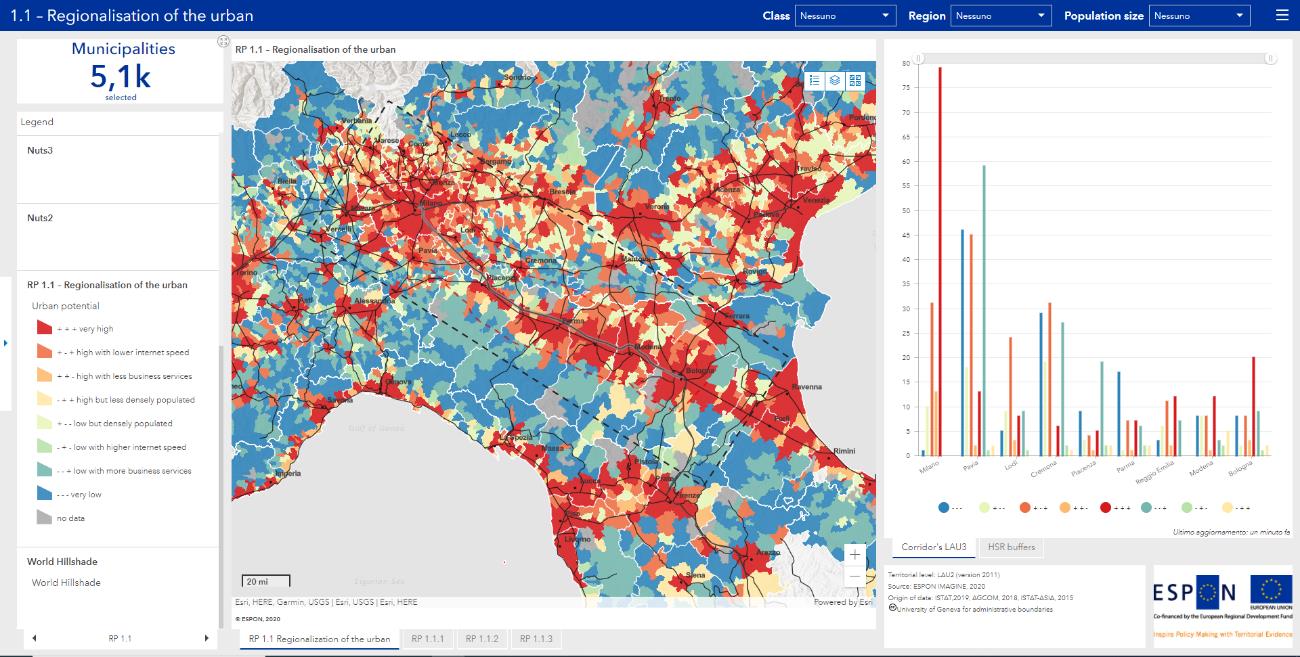
Visual Platform
The Visual Platform can be explored through two different tools: the IMAGINE Dashboards (based on ArcGIS Dashboard) and the IMAGINE WebApp (implemented and edited using the ArcGIS webapp builder application). Links to the Dashboards and WebApp are available in annex 6.
Contact
- Piera Petruzzi (Senior Project Expert) [email protected]
- Marta Roca (Financial Expert) [email protected]


